Tours and Activities:
The Bulls in Real San Carlos
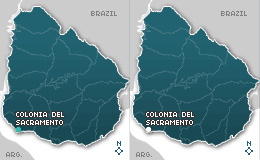
Pablo Etchevers Pablo EtcheversA few minutes from Colonia del Sacramento a wonderful treasure of bulls and bullfights can be discovered by any tourist. In order to understand it though, it is necessary to go back in time.

Bulls in Common
For many years, the Spanish and Portuguese people were involved in cruel fights to dominate the city. However, there was something bonding both parties, they had always felt attracted by the bullfights and the show they represented.
The construction of a tourist resort in 1908, which included a bull ring, was started by the union of Real San Carlos (the square was named after it). On its first day, January 9, 1910, the Uruguayan square dazzled with a gala that was equal to the most traditional festivals in Spain.
Famous bullfighters from the old world, like Ricardo and Rafael Torres ("the Bomb brothers”) were the cream of the crop. The stadiums were packed with 10.000 spectators, most of them coming from the neighboring City of Buenos Aires and nearby Montevideo. The square was baptized with the name of Plaza Real de San Carlos and it had a short success.

Mudéjar Architecture
Of purely Moorish origin, the square has a round arena, today covered by grass, and a grandstand that surrounds it and protects it with big horseshoe arches repeating themselves on its circular surface. Its Mudéjar architecture is the result of the blend between Muslim and Western expressions, typical of the Iberian Peninsula.
The bull feast attracted many spectators from the richest families, both from Buenos Aires and nearby Montevideo. They arrived in passenger steamships whose final destination was the pier Real San Carlos or the City of Colonia. The ship left them five blocks from the bull ring and there were wagons and carts taking the visitors to the gambling houses or to the very entrance of the ring.

Allowed In Uruguay
Some Argentinian investors based in Buenos Aires had the idea to build this venue. They had to negotiate with some Uruguayan businessmen, especially from the booming Montevideo of the time. As Argentina had been against these kinds of events, Uruguay became an important attraction for those who loved bullfighting.
The bullring was open for only two years and during this time there were 8 official bullfights. The last one to be recorded took place in February 1912. These kinds of events were banned in all the country by the Uruguayan government.
Ever since the prohibition became a law, the bullring, which in its glory could host the whole population of Colonia, was abandoned and only a few ghosts from those days keep bullfighting, running and bellowing just like they did in the past.

 See also:
 © 2007-2026 Total or partial reproduction forbidden. Derechos de Autor 675244 Ley 11723