Tours and Activities:
The Ombúes Woodland
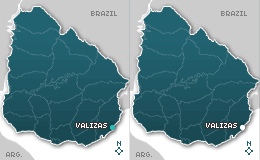
Florencia Pollack Florencia PollackWho would guess that after crossing Valizas Creek, visitors may access one of the most interesting tours in Northern Uruguay. The Ombúes Woodland is an adventure not to be missed.

Going up Valizas Creek towards the lagoon, there lies this group of ombúes, colossus among the trees, that give shape to an authentic forest and natural reservoir. Several tours start at the road and set out to discover them.
Towards a Special Forest
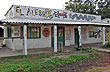
Agencia Monte Grande, which offers guided tours around the famous ombú woodland stands at the 267th kilometer marker on Route 10. To reach that place, we got on board a motorboat that would go up Valizas Creek and lead us to the point where Laguna de Castillos (Castles Lagoon) is located. There stands the Ombúes Woodland.
We found ourselves in front of what represents a unique project in the world: the fostering of the development of the ombú as the only species on this land. The understory has been pruned in such a way that the lianas that hang from the trees, the knots on the intricate branches and the multitude of leaves and seeds belong exclusively to the ombú.

Our Guide, an Olivera
The project is in charge of the Olivera family, who used to own the entire estate around Laguna de Castillos. Today, in its sixth generation, Juan Carlos runs the family legacy with dedication and he has turned the estate he inherited into a real nature reserve.
As we went off the motorboat opposite the access to the woodland, we were welcomed by Marcos, another family member who has been trained at ONG Provides in order to manage this project related to the ombúes woodland. He guided us among the trees and explained every detail about the life of the ombú as he answered all our questions.
"This is a group with quite varied interests", he commented with a pleasant smile. Some people ask about the medicinal use of the ombú leaves and seeds, others are in search for peculiar insects that dwell in this area or wish to learn more about the wood of this very special tree.

The Changing Tree
Sporadically, the ombú co-exists with the coronilla, another native tree.
Suddenly, we were in front of an impressive image: the two giants joint in one embrace, growing together since years ago. Marcos also told us about this species. There are only a couple of them present in the wood – let us remember that the ombú is the priority here. He knows the wood like the back of his hand.
Getting deep into this area, we saw trees that merge –and our guide explained this paradox exclusive of the ombú-, with thick long lianas that give shape to pronounced curves and join the tree on both ends; “the devil’s lianas”. The huge holes amidst the roots of the trees, strange formations along with the trunks –which turn out to be bacteria-, all this in a woodland proposing countless enigmas.

 See also:
 © 2007-2026 Total or partial reproduction forbidden. Derechos de Autor 675244 Ley 11723